Names stay in school
A pupil's name is encrypted and shown only to them and your own staff. Delta never puts it in an email or adds it to anything sent to an AI service. Pupils' information is hosted in the EU and is never used to train AI.
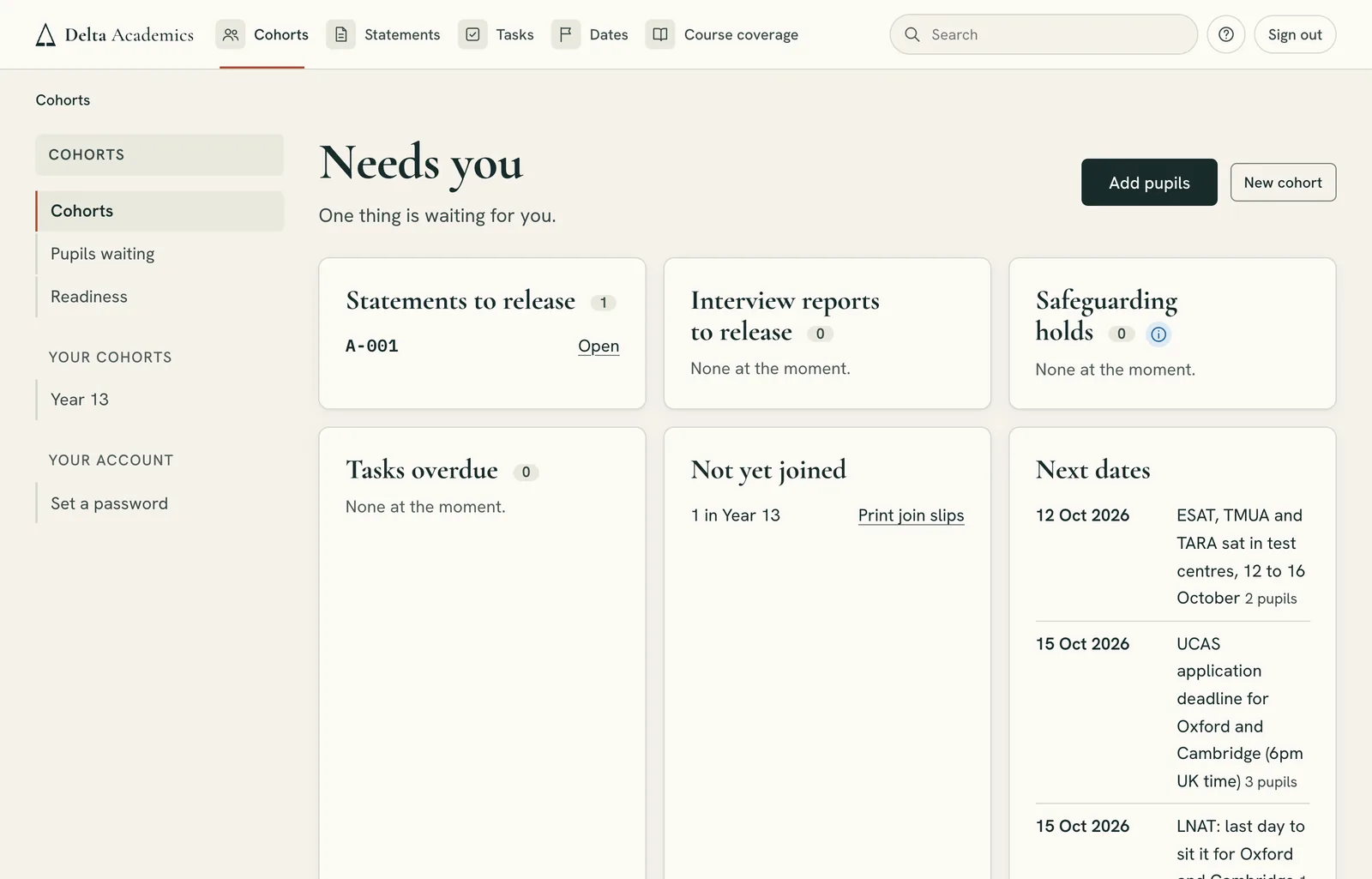
For Heads of Sixth Form and university advisers.
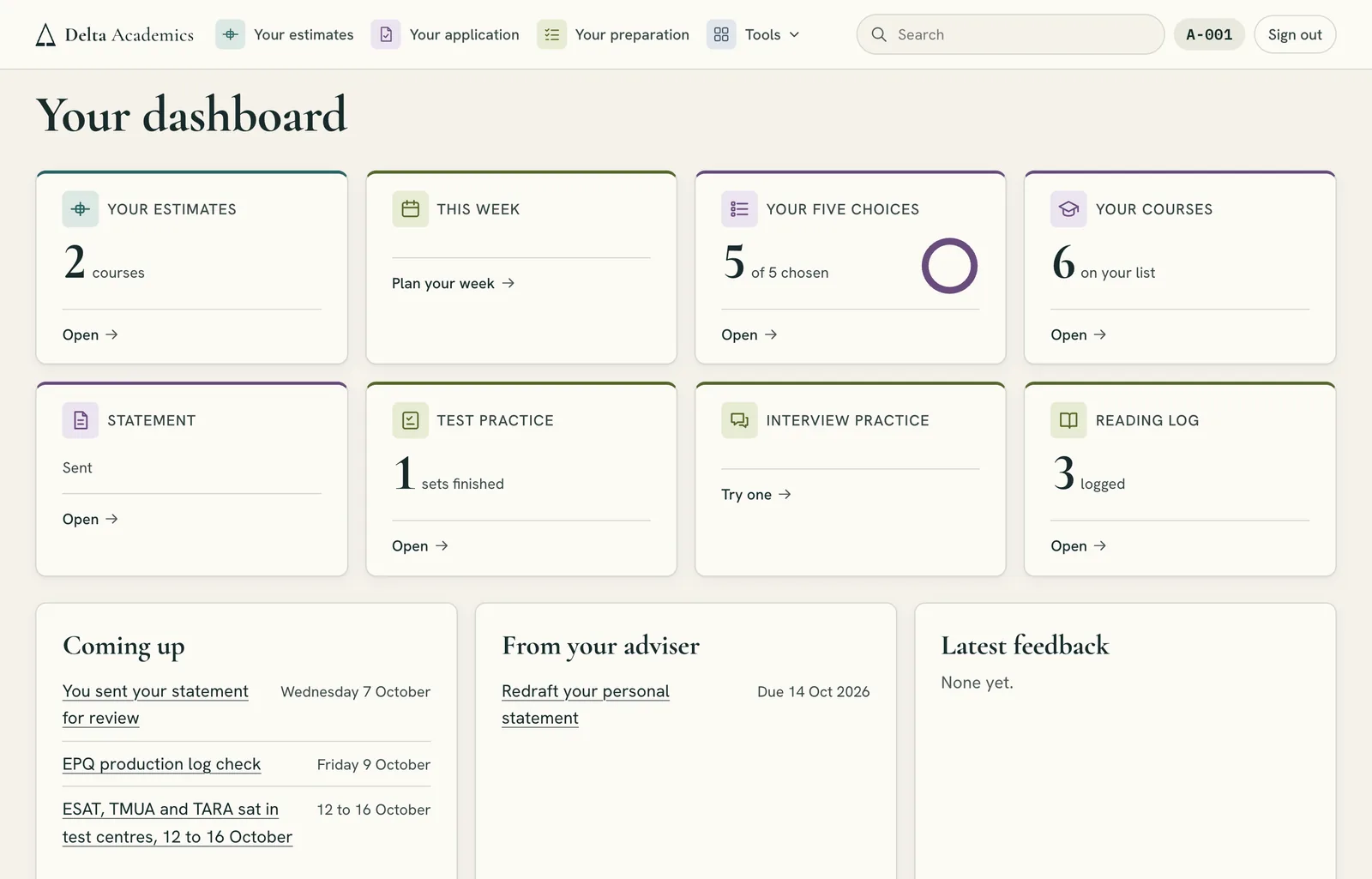
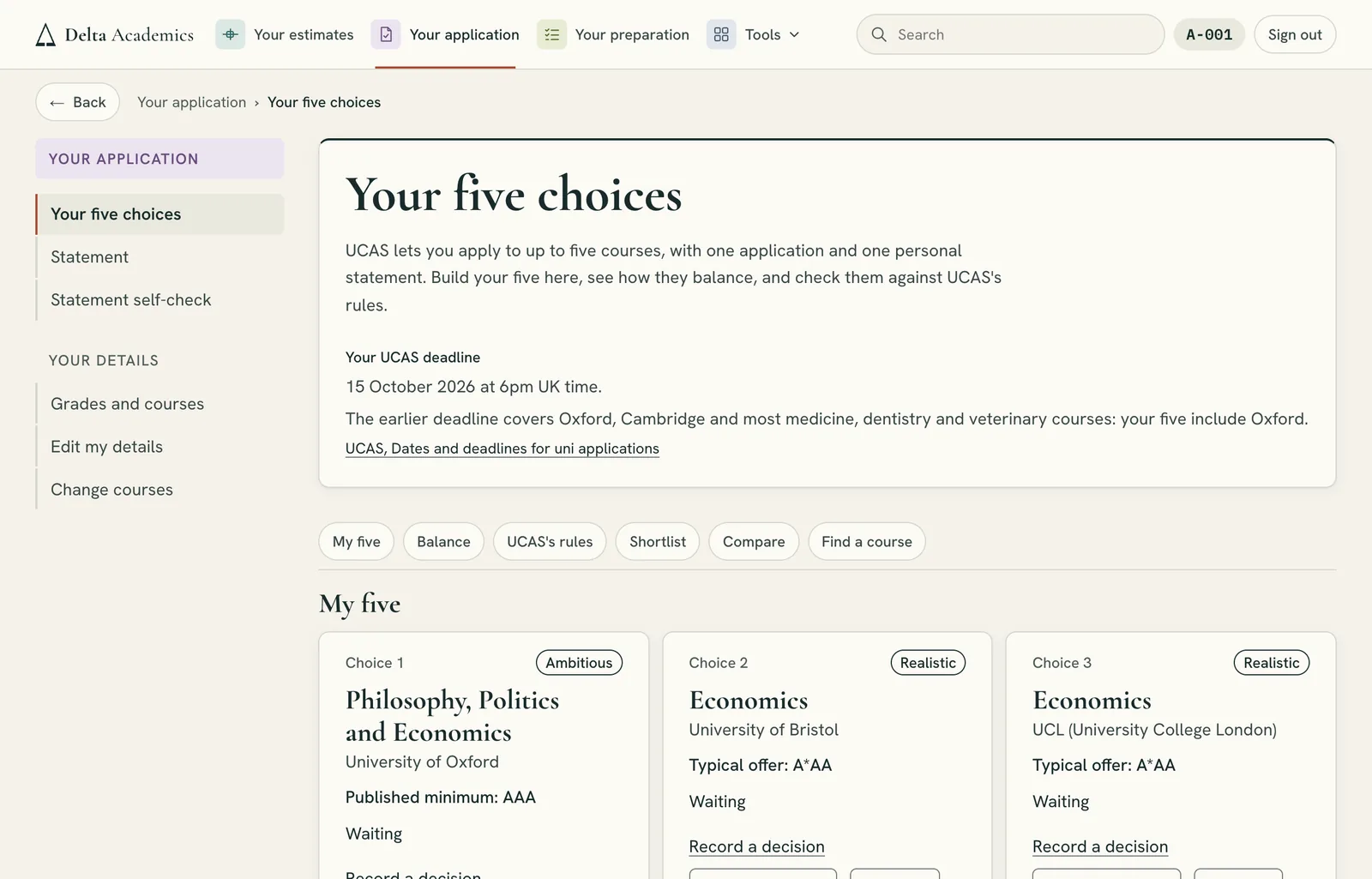
Admissions evidence, the five UCAS choices and every part of preparation, in one place.
For your pupils
For your advisers
For your school
A pupil's name is encrypted and shown only to them and your own staff. Delta never puts it in an email or adds it to anything sent to an AI service. Pupils' information is hosted in the EU and is never used to train AI.
Everything a pupil writes is read once for signs that they might need support. Your safeguarding lead is sent the pupil's label and username, the date and the few words concerned.
Pupils see the range of grades held by students who started a course, where it is published, never an average alone, so that a figure opens a conversation.
International schools
Delta reads A levels from any exam board, the IB Diploma and twelve more qualifications, and gives every deadline in UK time.
The twelve: Advanced Placement with the SAT or ACT, the French Baccalauréat, the European Baccalaureate, the German Abitur, India's CBSE and ISC, Australia's ATAR, Hong Kong's HKDSE, the Irish Leaving Certificate, Singapore-Cambridge A levels, Canada's provincial diplomas and CAPE. A pupil whose national diploma is not accepted on its own sees the figure for a route that would make them eligible.
What applying from another country involves: fee status, English language requirements, the Student visa, test centres abroad and online interviews, each taken from its official page and dated.
Pupils' information is hosted in the EU, and your school remains responsible for it under your own country's law.
The next step
We make a demonstration sixth form for you alone, with invented pupils whose work is already under way. You receive two links: one signs you in as a pupil, the other as an adviser.
It lasts 7, 14 or 30 days, statement feedback and practice interviews included.
What you will do
Every pupil in a demonstration is invented. The feedback you read is the feedback Delta would give your own pupils.
We agree the cohort, the tools, the dates and the support in writing. Your school signs a data processing agreement, names its safeguarding lead and gives us its advisers' school email addresses. Pupils join with the slips their adviser prints.
There is no commitment in asking for a demonstration.
Statement feedback, interview practice and the wellbeing checks use Mistral's EU service, which keeps nothing afterwards and does not train on it. A spoken interview answer goes to a transcription service in the EU, becomes text, and is deleted there within seconds.
Your school receives the data processing agreement and the privacy notices before any pupil joins.
Everything a pupil writes in Delta is read once for signs that they might need support. If there are any, your safeguarding lead is sent the pupil's label and username, the date and the few words concerned, never their name, and any feedback waits.
Your school responds under its own safeguarding policy. Delta is not an emergency service.
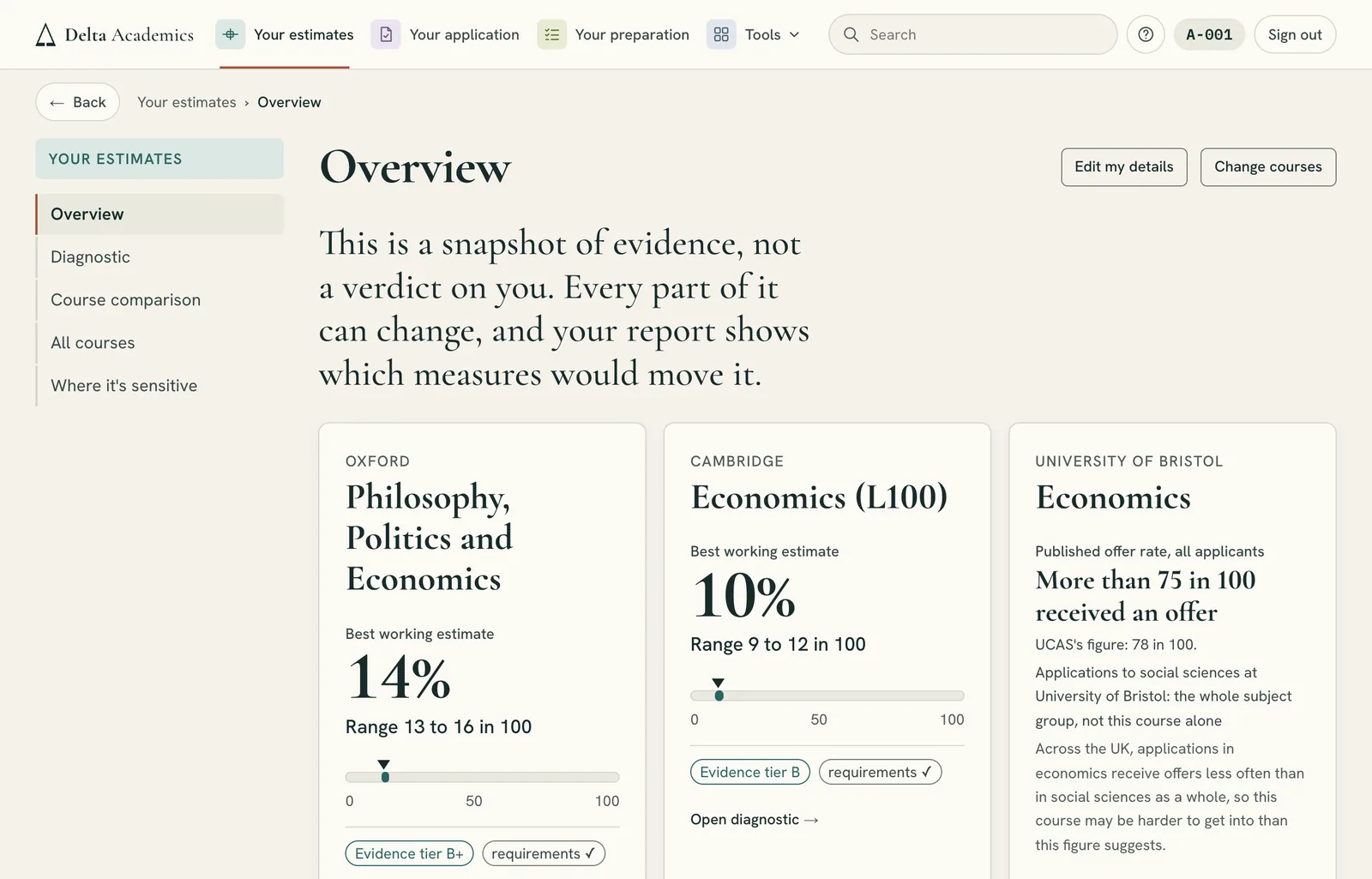
For 75 Oxford and Cambridge courses, Delta gives each pupil a range drawn from published admissions figures, and says how strong the evidence behind it is. For courses at other universities it shows what is published: typical offers, and the grades of the students who started the course.
A range is an estimate, never a promise of a place, and it does not replace a conversation with a teacher.
Showing admissions data can change the choices pupils make. A 2023 study in the United States found that one widely used tool made high achievers more likely to apply only where they were overqualified.
Delta is built the other way: it shows the whole range of grades and encourages pupils to discuss an ambitious choice. Read the study by Tomkins and colleagues.
Founding schools, 2026-27
Delta is taking founding schools for 2026-27: international schools whose pupils apply to UK universities, and state sixth forms, sixth-form colleges and academy trusts in the UK. A demonstration takes one email to arrange.